
Our honest verdict
Timber linings are warm but sag, stain and rot in exposed eaves and alfresco ceilings. Aluminium linings stay flat, hold colour and will not rot, which is why they dominate outdoor ceilings.
Timber overhead
Timber ceiling and soffit linings look beautiful but are exposed to weather without the run-off a wall gets. They can sag, stain, rot and peel, and they need repainting or re-oiling on a cycle.
Aluminium overhead
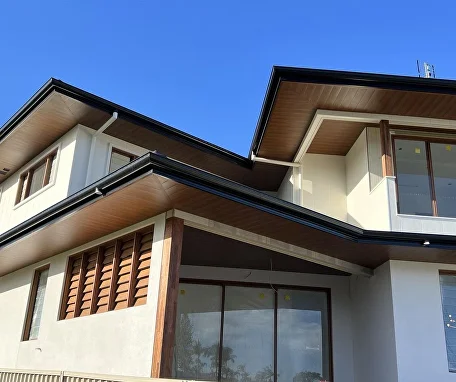
Lightweight aluminium linings stay flat, will not rot or sag, and hold their woodgrain colour even on sun-baked eaves. They are safer to install overhead and carry the same finish as matching cladding and battens for a resolved look.
Honest trade-off
A protected internal ceiling can be real timber. For external soffits, eaves and alfresco ceilings, aluminium is the durable choice that avoids the classic timber-lining failures.
The two contenders
Woodgrain aluminium
Solid marine-grade aluminium with a sublimated woodgrain coat. Non-combustible substrate, holds its day-one colour, and needs only an occasional wash - no oiling, no recoating.
Timber lining
Overhead is where natural timber struggles most - here is how the two compare for eaves and alfresco ceilings.
At a glance
Side by side on the points that decide most projects.
| Factor | Woodgrain aluminium | Timber lining |
|---|---|---|
| Sagging | Stays flat | Can sag over time |
| Rot | None | Rots if it stays damp |
| Upkeep | Occasional wash | Repaint/re-oil cycle |
| Bushfire eaves | Non-combustible substrate | Combustible |
The Woodonali product
Warm timber-look linings for eaves, alfresco ceilings and feature soffits - lightweight aluminium that will not sag, rot or peel in the weather.
Get a real comparison for your project
Send your elevations or rough areas and we will price the woodgrain aluminium option in AUD, so you can compare it against the alternative on the numbers that matter to you.
Other comparisons
Woodgrain Aluminium Cladding vs Natural Timber Cladding
The look is close; the lifecycle is not. Here is where each material genuinely wins.
Compare ›
Woodgrain Aluminium vs Composite / ACP Cladding
Both are aluminium-faced. The difference is what sits in the middle - and that matters for fire.
Compare ›
Woodgrain Aluminium vs Fibre Cement Cladding
Fibre cement is the value workhorse; aluminium is lighter and carries a more convincing timber grain.
Compare ›
Woodgrain Aluminium vs Vinyl (PVC) Cladding
Vinyl is cheap and easy; aluminium is non-combustible and holds up far better under Australian sun.
Compare ›
Woodgrain Aluminium vs Colorbond Steel Cladding
Two non-combustible metals with different jobs: steel for crisp solid-colour profiles, aluminium for a warm timber look.
Compare ›
Woodgrain Aluminium vs Brick or Rendered Walls
Masonry is the durable base; woodgrain aluminium is the warm face you add over or beside it.
Compare ›Planning a woodgrain aluminium project?
Talk to our Australian team for obligation-free advice, samples and pricing in AUD.